
5 things every marketer needs to focus on in 2026
How to prepare yourself for a whole new year in the changing world of marketing
We marketers (and founders/builders trying to do marketing) are in a weird place right now. There has been a tectonic shift in marketing with AI, and I don’t think we are adapting very well (I certainly haven’t).
But it’s not just marketing that’s shifting. The nature of the products we build and sell are also being transformed with AI. Business models are changing, the tactics we used to rely upon are obsolete. Like I wrote last year, there seem to be only two strategies left in B2B marketing. There’s a reset happening.
There are two ways to deal with this. One is to be cautious, focus on the fundamentals, and be incremental in your adoption of everything that AI is bringing to the table. The other is to go all-in on AI, experiment with every tool out there, and leverage AI relentlessly to try to do a lot more with less. There are success stories on both sides, and though I think the answer, as usual, is somewhere in the middle, I’m not really sure. It’s subjective, is the lame, antiseptic conclusion I’m drawn to.
I know, that’s annoying, but different kinds of products can run on different kinds of marketing now, and there is no one-size-fits-all, or even a rudimentary pattern to follow.
The plight of the marketer in the AI age
This puts us marketers in a difficult situation, because those of us with more than 10 years of experience have specialised skills. We are either brand marketers, or funnel marketers, or inbound guys, or SEM operators. With AI, the value of these specialisations has gone down, irritatingly and immediately. Our specialisations don’t matter in this new world, where you simply cannot rely on channel/tactic superiority.
On the other hand, if you are younger, you have the know-how accessible with AI, but do not have the experience of blending in old school basics. This puts juniors on the back foot too. And in all of this, the expectations from us are higher than ever.
This is where 2026 finds us all.
But we cannot become despondent, nor can we become luddites. Change comes for everyone and everything, and this time it’s us. I’ve been thinking about how we should be navigating this time of exciting, but also annoying, technological innovation. This is also why I like working at Atomicwork, where AI is central to how we think about not just the product, but the whole business itself. That way, even if I’m reluctant, I’m forced to learn, act, and respond.
Our focus areas for 2026
This line of thought forced me to look over my experience of marketing over the last couple of years, and how I’m seeing the field evolve. From where I sit, these should be our focus areas for this year:
Think AI strategy, not AI tactics
First, as I’ve always said in this newsletter, focus on the basics. Those still don’t change. Especially as founders, don’t let all the fancy things going on in the world distract you from the fact that you still have to get positioning, messaging, brand voice, and visual language right. But once you have done that and have an idea of your marketing strategy, incorporate AI into every part, but not as a tactic. Make it part of the strategy. For example, don’t think how you can write better emails with AI, think whether you can use AI to skip the email itself and go directly in some other way to your target audience. If you are planning a campaign, think how you can use AI to get better segmentation or get better intent signals, and then hit them up.
What I’m trying to say here is that we all know AI can help us get better at the tactics, but are we thinking about how it can help us think through first principles? If AI only makes you faster at old tactics, we will miss its real value. Be warned that this unlearning is difficult to do. We are used to thinking in channels and tactics (I’m guilty too!), but we have to get beyond that.
Your marketing has to feel human
This is an important counter-point to what I said above. A few days ago, I saw a friend of mine, a podcaster, write about a new initiative he was launching. And it was so clearly written by AI that he immediately lost me. People can tell, he had had no engagement on that post. This one is just a small example, but imagine the impact of this lack of credibility when you are running a startup or marketing a product, and when the things you create are being seen by prospects, investors, and the market.
This is very important to understand, copy-pasting signals a lack of effort. This is across anything you are doing: Content, campaigns, images, social. So when you use AI, you actually have to put in double the effort to make sure you come across as authentic.
Own your distribution
One development I saw early was the rise of branded content. I have written earlier about how my team and I planned and executed this at Atomicwork. It’s still early days, but startups that choose to own their distribution, create IPs like podcasts and YouTube channels and Instagram pages, will have a huge advantage over those who don’t. This is a greenfield area in both B2B and B2C, and the why of it needs a separate discussion.
But the fact is that it’s there, and it’s an opportunity marketers need to immediately tap into. This is why I’m bullish on founders wanting to be visible and telling their own story. That is the first step to understanding that you can basically create your own media empire to sell your product. If you don’t invest in this, you are ignoring a strategy your competition will absolutely, definitely use.
Bring enablement front-and-centre
If you think life is tough for you as marketers, just take a look at what has happened to the sales functions. There was a time when the difference between a good sales person and an okay one was simply the time they invested in research and preparation. You could just be so much more better if you did the research, understood the prospect and the company, and sold to a pain point. But with AI, all of this is automated, and the average sales folks are now good too.
So how do you help your startup’s sales team differentiate? Simple, use AI to help them with the best sales enablement you can do. The better you can get at giving them what they need to close the deal, the faster they will close deals. (Check out Rampkit for bespoke sales collateral for your team, friend runs it, and his services might help you scale).
Tie every initiative to pipe impact
There is no choice for you except to do a lot more as a marketer in 2026. And when you do, tie it back to pipe. One trend I have noticed in the last year is that founders are asking for more and more clarity on the ROI that both branding and AI initiatives are giving the org. This is understandable, given how expensive and ambitious it is becoming as a startup (or as a slightly mature business) to run either. So start thinking pipeline impact for everything you do, and see if that helps you get better.
Sure, as I have said before, when you are very early, trying to measure everything will just slow you down. But as you grow, start building in the measurement and optimisation muscle. Your CEO will have this question for you sooner or later. Get ready with the answer.
So there, that’s my list. If there’s anything I’m missing, it is the resurgence of field marketing, and events as a lead source. I have not included it as I think that’s a realisation all of us had last year.
Would love to know if you have any more, please comment. And do share this with your colleagues.
One more thing: Introducing Marketers United
So I’ve finally launched Marketers United, a small WhatsApp community for marketers who want to learn, share, and just talk honestly about the work we do.
This is something I’ve been wanting to do for over a year, and quite a few of you have written to me about it too. On Republic Day 2026, it has finally came alive. Those of you who have already emailed me, you should have the invites in your inbox. If you’d like to join, just email me at sairamkrishnan@outlook.com and I’ll send one across.
The idea is very simple. I want this to be an intimate, low-noise space where marketers can be themselves, ask questions they might not ask publicly, and learn from each other without the pressure to perform, or sound smart.
I’m also planning a small in-person meet-up in late February, so it would be great to have you join early and be part of shaping what this becomes.
And finally, if you haven’t subscribed to this newsletter yet, here’s your nudge. It’s a new year, and more than 5,000 marketers already get this in their inbox every Monday. Looking forward to having you as part of this journey. :)
Volunteering
Lest people forget that I was an OG SaaSBoomi volunteer, I’m helping organise an amazing workshop this coming Saturday with Sudip Dutta, CEO of Relatas, on Storytelling for Founders.
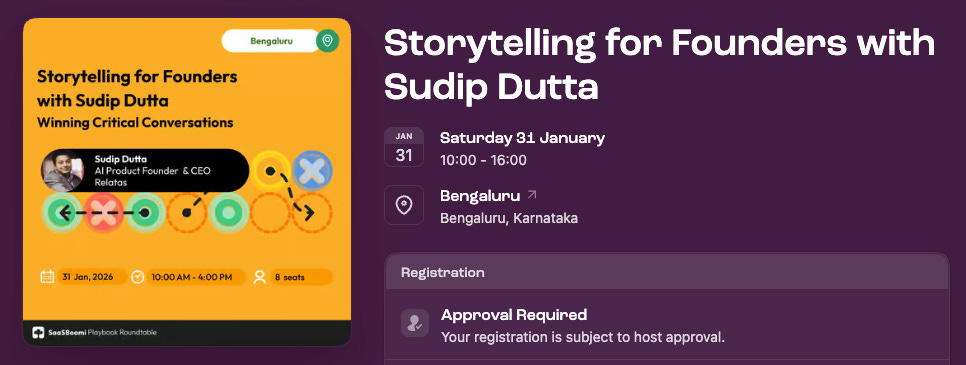
This is especially for founders with startups in the $3–$10M ARR range, and this is a closed-room, hands-on workshop. Do spread the word, the form to apply is here.
I’m looking forward to volunteering again.
Solid takeaway in that piece, it reminds us that while tools shift (AI especially), the core job of marketing doesn’t: strategy first, human connection second. Laying a foundation that embraces change but doesn’t lose sight of fundamentals is exactly the mindset founders and CMOs need to thrive in 2026. Thanks for a great read, Sairam.
Love this perspective on the AI shift in marketing. You really captured the current dilemma and how subjective things feel right now. It's a huge reset.